
Turandot, a western tale of the lotus flower and dragon lady🪷
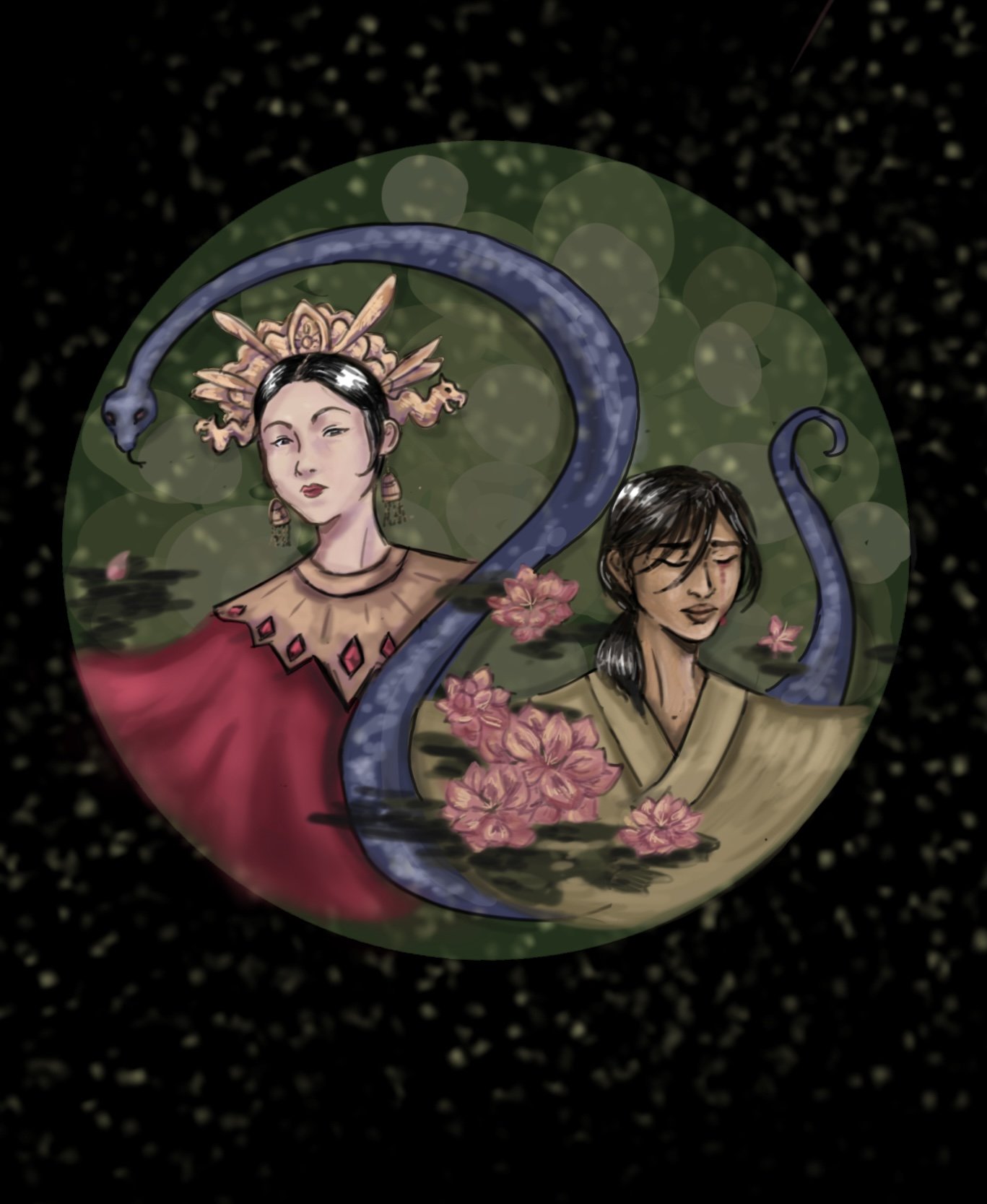
My digital illustration of Princess Turandot on the left and peasant girl, Liu, on the right. It is important to note that the headpiece for Turandot that I drew is based more on the old opera posters and stage productions for Turandot and not entirely accurate to historical imperial Chinese crowns.
Set against the backdrop of a fictional ancient China, Turandot, an incredibly famous opera written in 1926 by renowned Italian composer, Giacomo Puccini, is widely regarded as one of the hallmarks of opera (Turandot | Metropolitan Opera, n.d.). The story follows Prince Calaf, a foreign prince who falls in love with the cruel Chinese princess, Turandot, known for sending numerous foreign princes to their deaths after they failed to answer her three riddles correctly in exchange for her hand in marriage. Desiring to wed her, Prince Calaf takes on Turandot’s conditions under a pseudonym and correctly guesses all three riddles, thus binding her to her terms of marriage to her horror. Prince Calaf, feeling sympathetic, provides her a chance to escape by offering her his own riddle: correctly stating his real name and granting her permission to kill him if she succeeds. Remembering that a Chinese peasant girl named Liu knew Prince Calaf’s true identity, Turandot has her tortured in an attempt to reveal Calaf’s name, but Liu refuses, claiming that love gives her the strength to resist, and kills herself to prevent the secret from coming out. Later, Calaf confronts Turandot and kisses her, then reveals his true identity. Overwhelmed with emotion, Turandot declares that the prince’s name is “Love”. It’s important to note that Turandot is not based on any true historical occurrences in China, as it is entirely imaginary, cemented in perceptions of the East as mysterious and barbaric. The sensationalist portrayal of the Chinese princess and romanticism of Turandot echoes orientalist ideas by perpetuating tropes of the antagonistic Asian “Dragon Lady” seen in Turandot’s character and docile lotus blossom in Liu’s character. While these characters subvert the stereotypical archetypes in some ways, they serve to further enforce the perceived backwardness of the imagined East and justify Western influence as morally dominant and benevolent.
Liu, the Chinese servant girl, embodies the stereotype of the “Lotus Flower” by being a passive story tool to characterize the noble nature of the prince and catalyze the culmination of the central romance. The “Lotus Flower” is a media portrayal based on the stereotype of Asian women being passive and submissive. Her affections and actions are often in service of the white male lead. Likewise, Liu, the Chinese peasant girl, falls helplessly in love with Prince Calaf, who unfortunately does not reciprocate her affections. As the “Lotus Flower”, Liu is depicted as innocently pitiful, yet undeserving of love and attention. She is consistently sidelined in the love story, appearing less desirable and less valuable than Princess Turandot to Prince Calaf, who is willing to put his life on the line to fulfill Turandot’s need for love yet would not come to the rescue of Liu in her greatest time of need. As such, Liu’s tragic sacrifice serves as a plot tool to prove the desirability and goodness of the foreign prince rather than providing any sort of characterization, depth, or personhood to herself, as her own desires and future are never addressed. While her selfless action makes her a more active character in contrast to typically passive portrayals of the “Lotus Flower,” all of her motives and actions revolve around providing happiness to the prince, including encouraging Turandot to pursue love with him.
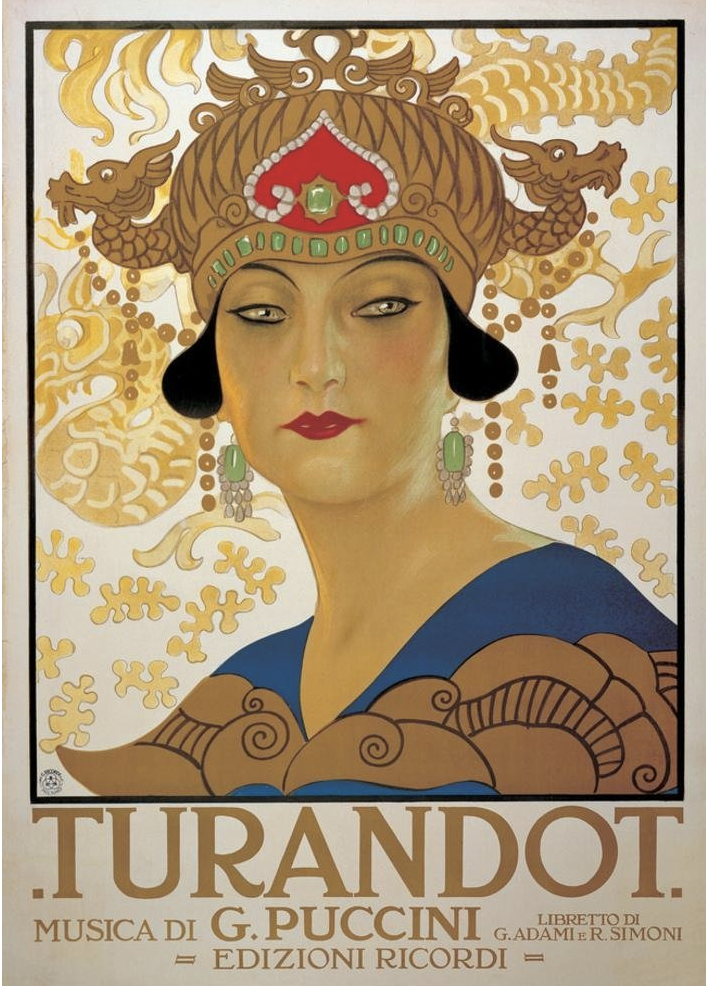
Turandot poster from Italy
In contrast, Turandot encompasses the stereotype of the fearsome “Dragon Lady,” further cementing the idea of Western culture being a benevolent force of progress for the backwards ways of the East. The “Dragon Lady” is usually known for her seductive beauty, often characterized as being cruel or deceptive, and her allure poses a direct threat to the male lead. As is common with the dangerous allure of the “Dragon Lady”, Prince Calaf’s obsession with Turandot puts his own life on the line in multiple instances. However, Puccini does subvert this usually one-dimensional villain archetype by providing Turandot a justifiable reason for her heinous actions: Turandot anger and killing of foreign princes is a form of revenge for her female ancestor, who was raped and killed by white men. Despite this reasoning, Turandot’s revenge is portrayed as being entirely wrong, and Prince Calaf’s is the white man who must tame her and teach her to love, without ever addressing the underlying systems that allowed for the atrocity that happened to Turandot’s ancestor. This western romanticism that “love conquers all” fails to fully acknowledge or rectify the unwelcome domination and exploitation of western forces into the East, from land, resources, to their very bodies. While Turandot has every right to feel angry at the injustice, the blame for her revenge, and by extension the reactionary aggression and actions of the East, is put squarely on her shoulders. It is Turandot who must change her ways; meanwhile, Prince Calaf never has to change.
While Turandot subverts the “Lotus Blossom” and “Dragon Lady” tropes to some extent and brings more agency to its female characters, Princess Turandot and Liu further reinforce notions of western moral superiority over the East. Interestingly, this story could have had a potentially different message. Puccini passed away before he could write the final act, having only finished writing up to Liu’s death. Numerous people have attempted to write suitable endings, and the most commonly accepted fourth act that continues to be performed at opera houses worldwide, was written by one of his students who opted for a happier romantic ending. I always felt that the common ending to his story felt overly simplistic and unsatisfactory. Would Puccini have opted for this orientalist narrative or would he have provided Turandot a different form of agency?
