
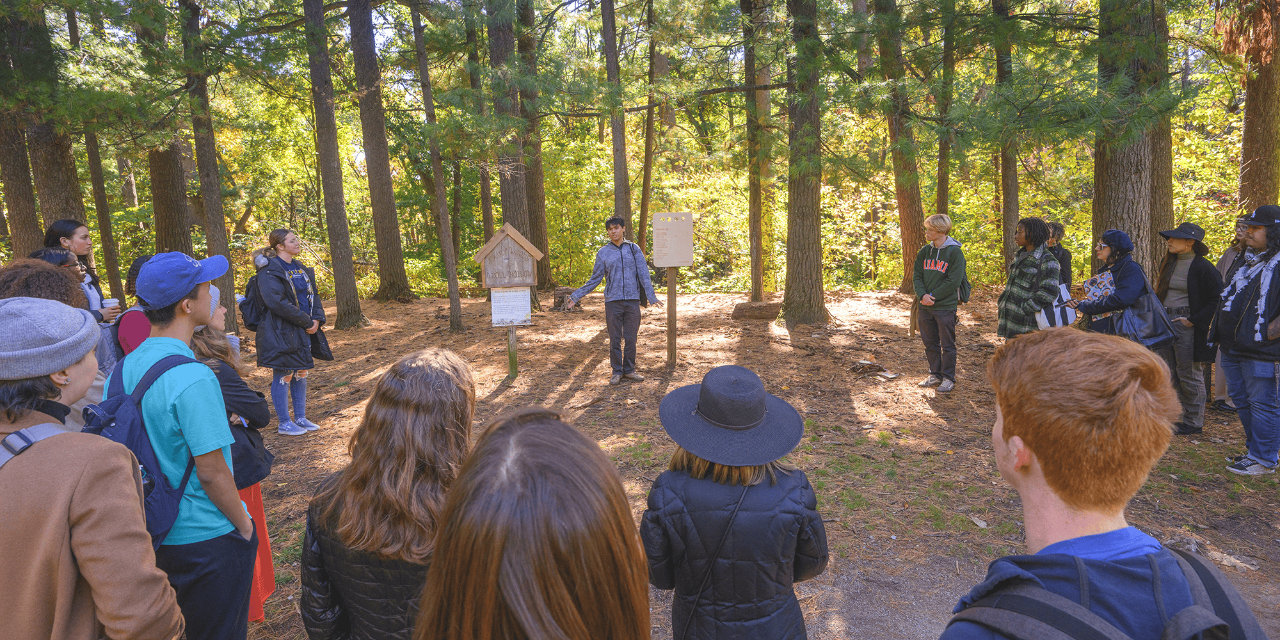
Student Shao-Chi Ou guides a group of visitors along the Earth Song exhibit trail through the Arb. Photography by Doug Coombe
Students transform the Arb into an art exhibit, guiding visitors with poetry and connection, and reminding us that “the earth is a living thing.”
The message on a wooden placard at the U-M Nichols Arboretum instructed visitors to “Walk/through the garden’s dormant splendor./Say only, thank you.”
On a golden fall day in the Arb, visitors could do just that: walk a trail near dormant peony beds, guided not by map or botanical information, but by poetry—a different kind of navigation system.
Eleven poems lined this path through the Arb from fall to early winter—part of a student project and open-air exhibition called Earth Song, which signaled a network of historic relationships between Black people and the natural world. With QR codes at the bottom of each sign, visitors could connect to a student’s voice reciting the poem inscribed on the wood: Carl Phillips’s “White Dog,” or two of Richard Wright’s nature haikus, or Lucille Clifton’s “the earth is a living thing,” or Ross Gay’s “Thank You,” quoted above.
The placards and their poetry invited trailwalkers to pause, to read, to contemplate—and, as Gay wrote, to say “thank you.”
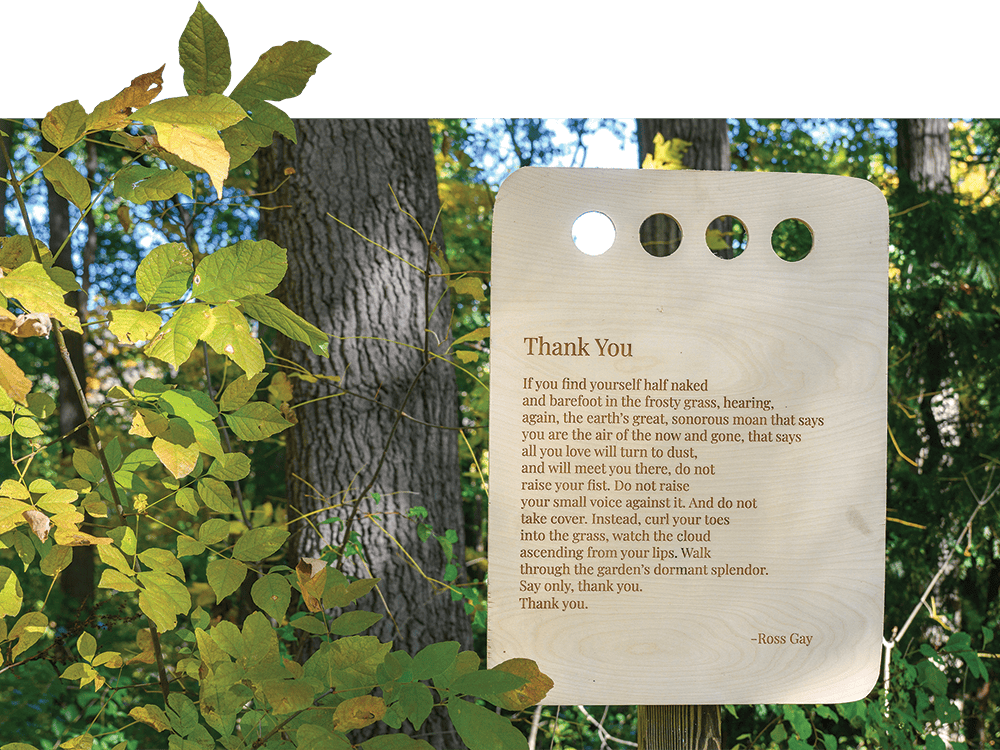
Ross Gay’s poem “Thank You” is part of the Earth Song exhibit. The 11 poems students chose for Earth Song were inscribed by laser onto wooden placards and placed on the posts along the trail.
Always Part of the Natural World
Earth Song was born of the initiative of students of Professor Bénédicte Boisseron’s “Black Ecologies” course in the Department of Afroamerican and African Studies. Black people have always been a part of the natural world, Boisseron says, though the legacy of slavery, segregation, and racism often erases Black presence from nature histories, and makes Black people feel unwelcome in the great outdoors today.
“For a Black birdwatcher, gardener, or dog walker,” Boisseron asks, “is there such a thing as ‘being in nature while Black?’” She references the infamous 2020 incident of Christian Cooper, who was falsely accused of threatening a white woman while he was birdwatching in Central Park. One of Boisseron’s goals in teaching the course is to reframe preconceived ideas about Black people’s relationship with nature.
Through an exploration of literature, podcasts, visual art, and experiential learning, Boisseron encourages her students to get outside and explore.
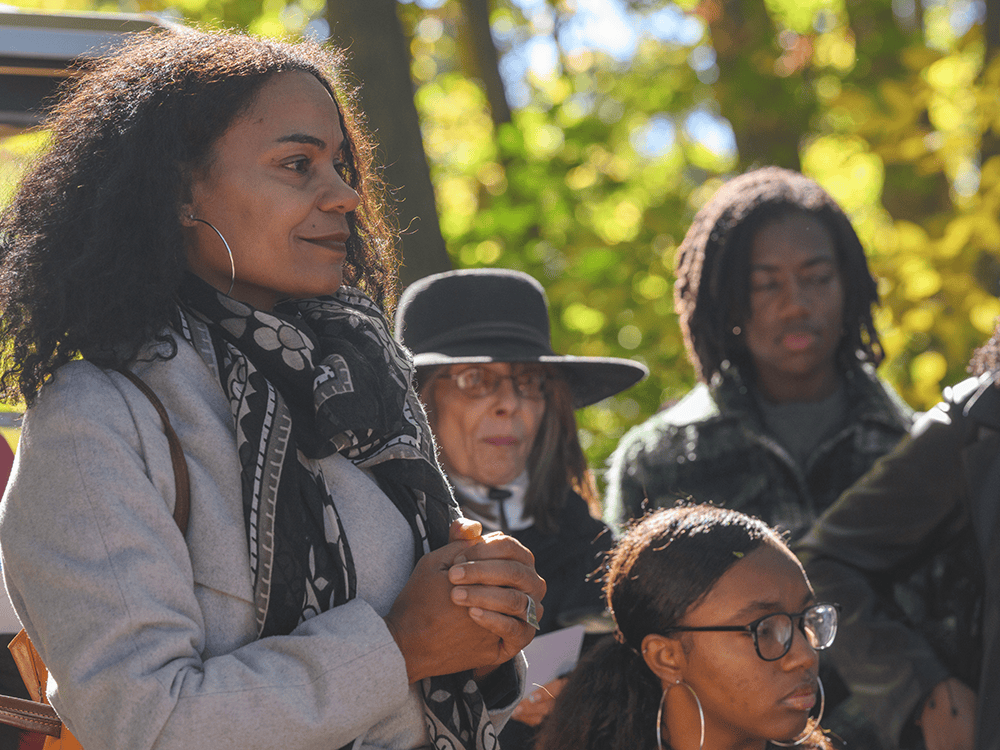
Professor Bénédicte Boisseron shares a lesser-known fragment of Black history entwined with the creation of the Arb, found in a letter from a former Arb director: a mention of 34 unnamed Black workers who dug Arb trails in the early 1930s. Boisseron and her students began working with archives in Lansing and Washington, D.C., to uncover the workers’ names.
“Why not start ... an earthly movement ... from east to west, north to south, within the country and beyond, in a Black diasporic chain?”
—Professor Bénédicte Boisseron
Students Lead the Way
Boisseron’s students were inspired to create Earth Song after she introduced them to a 2022 exhibit called The Bond of Living Things Everywhere, curated by poet and scholar Joshua Bennett, an immersive exhibit that introduced the work of Black poets and writers into the New York Botanical Garden grounds. Boisseron and her students agreed: This kind of exhibit needed to travel.
Boisseron’s students led the charge to introduce the work of Black poets into their local environment. They chose the Arb as their installation site. Together the group read an anthology edited by poet Camille Dungy called Black Nature: Four Centuries of African American Nature Poetry, and selected 10 poems to introduce into the Arb. The name of their installation is a nod to the Langston Hughes poem “An Earth Song.”
“Reading this poetry has been really good for me as a Black person,” says student Chidimma Udegbunam. “There’s this idea that Black people really aren’t outside, but for me these poems are a way to reenter nature, and to reclaim nature.”
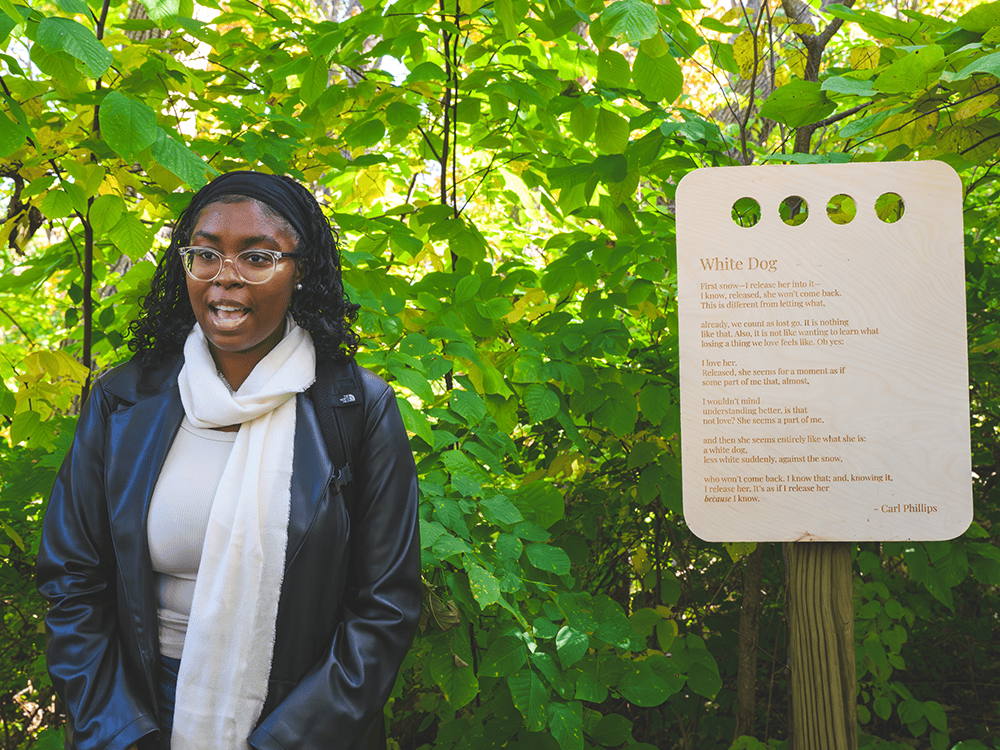
Student Chidimma Udegbunam leads visitors to the Earth Song exhibit through a close reading of Carl Phillips’s poem “White Dog.”
We Have to Talk About Joy
Selecting the poems as a group was a process of balancing sadness with joy, says student Shao-Chi Ou. “We need both; it’s important to enjoy things,” he says.
“We have to talk about joy,” Boisseron adds. “Racism is not individual; it is systemic. But the tension between racist systems and individuals is very important in this class, because there’s something intimate about the joy we experience in nature.”
Many of the poems that students selected hold painful histories and resound with joy at once—such as this exaltant stanza from Lucille Clifton’s “the earth is a living thing”:
is a black and living thing
is a favorite child
of the universe
feel her rolling her hand
in its kinky hair
feel her brushing it clean
Student Diya Mitchell says of the poem, “[It] immediately spoke to me because of the way Clifton described the beauty of nature [in terms of] the experiences of Black women. She is celebrated, yet picked away at. She is both loved and exploited.”
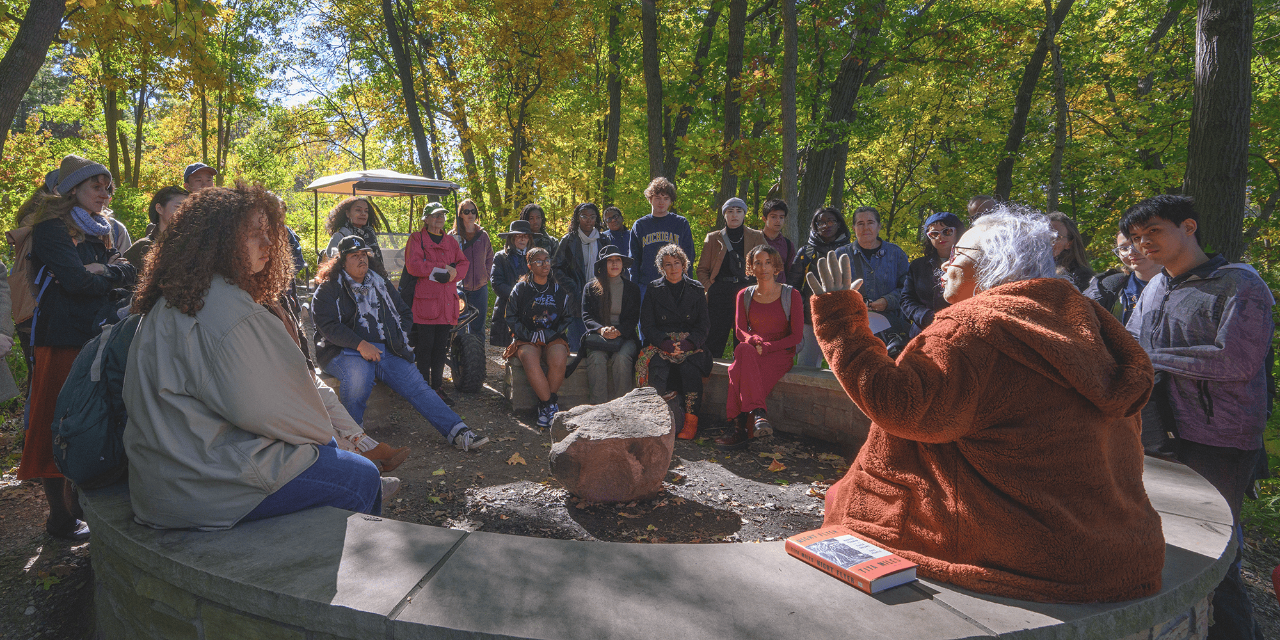
DAAS program coordinator Elizabeth James shares Black and Indigenous nature stories at the Arb’s stone amphitheater at the end of the poetry trail, at the opening ceremony of the Earth Song exhibit.
The final poem on the path was not selected from the Black Nature anthology like the others. It was written by Marcellus Williams, an incarcerated poet whose controversial execution, in September, took place shortly before the exhibit in the Arb opened.
In the lines of Williams’s poem “At Last ... Another Heartbeat,” student Sophia Lane observes, is “a communion with the environment that affirms the universal connection of live beings everywhere, a unified heartbeat.”
In mid-October, students gathered in the Arb with Boisseron and community members for the opening of Earth Song. Students led a procession through the woods, stopping at each placard to introduce and recite the inscribed poem for attendees. Poetry and footsteps echoed in soft beats along the path, similar to that “unified heartbeat” that Lane hears in Williams’s lines.
As they proceeded, the atmosphere shifted. The students’ words seemed to alter the autumn light on the Arb’s magnificent pines, meadows, and switchback paths, imbuing the Arb with a reverent song for the lives and stories held here. Claude McKay’s lines, written on a nearby placard framed by a golden maple, seemed especially resonant: “There is joy in the woods just now/ The leaves are whispers of song.”
Read more about Earth Song and listen to the students of “Black Ecologies” reciting the project’s poems here.