American Sampler: An Archive of Protest Art Meets the Moment
University of Michigan Museum of Art spotlights “a long twentieth-century history of dissent”
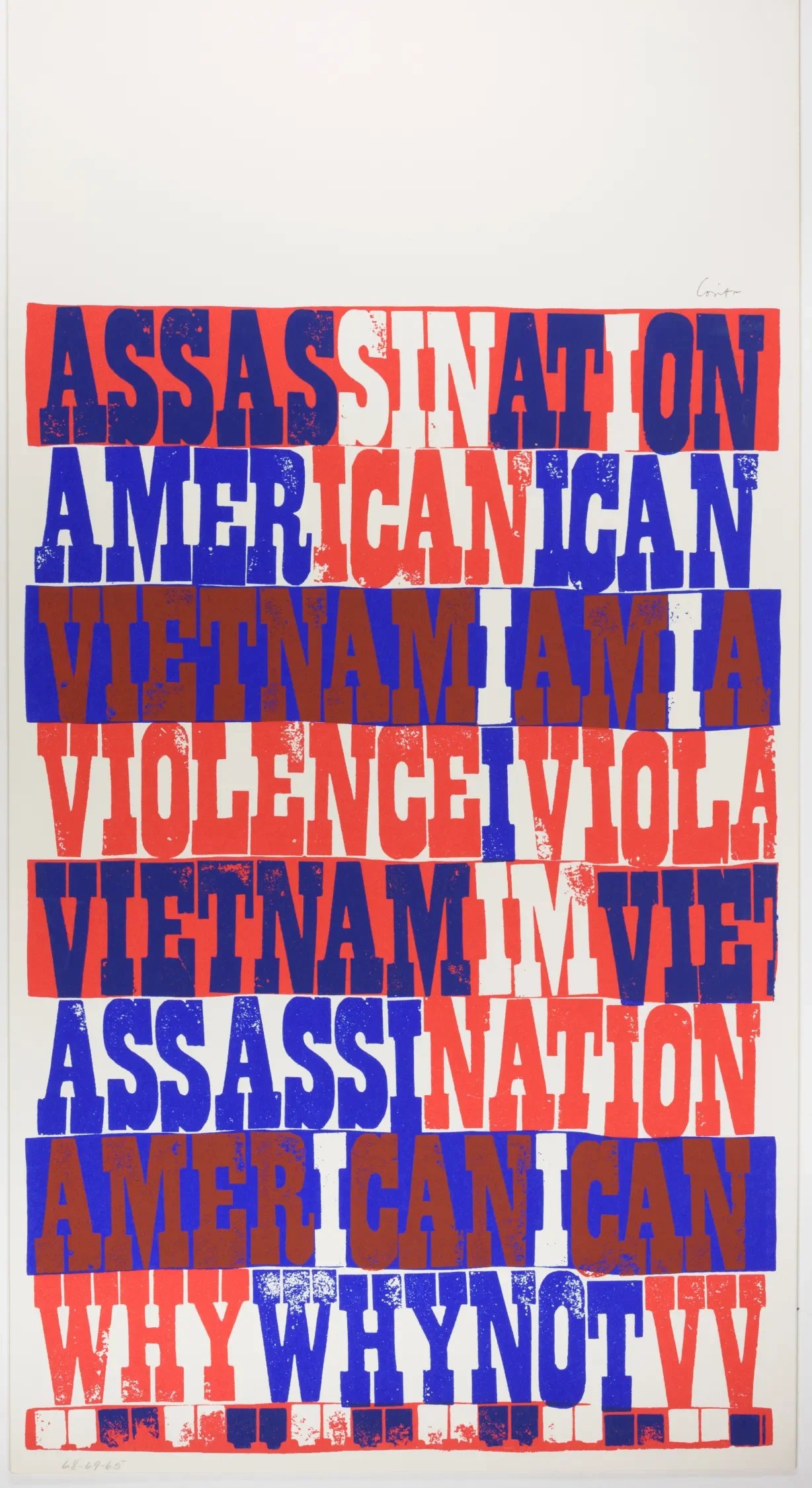
Corita Kent, american sampler, 1969, serigraph, 23 × 12″.
Ongoing—“I wouldn’t be at all surprised if the Labadie Collection grew to be quite a firebrand in Ann Arbor, as l want it to contain the most radical stuff printed,” wrote anarchist and labor organizer Jo Labadie in 1927. He had donated his trove of pamphlets, books, newspapers, and other ephemera to the University of Michigan in 1911, where it seeded a still growing corpus of archival materials related to activism and organizing. Today, the Labadie Collection is a one-of-a-kind repository of publications, manuscripts, and recordings indexing a long twentieth-century history of dissent, from anti-colonial and anti-war protests to civil and workers’ rights movements, as well as feminist and LGBTQ struggles for equality and recognition.
Julie Ault’s exhibition, “American Sampler: Activating the Archive,” emerges from the artist’s research into this unique collection, in dialogue with its longtime curator Julie Herrada. No stranger to orchestrating relational encounters between artworks and archives, Ault is an astute mediator of this vast repository, which she puts in punctual dialogue with works from her own collection and that of the University of Michigan Museum of Art (UMMA). It is at the invitation of the latter that she has filled its forty-foot-tall Vertical Gallery, located at the institution’s core, transforming it into a space for visitors and passersby to consider strategies for effective resistance. By homing in on the period of the late 1950s to the late ’70s, an era that still resonates strongly in the popular imagination as one of explosive—and efficacious—political action in the United States, Ault’s show provokes an urgent if obvious question: How might we continue to organize and confront the rampant injustices, inequities, violence, and horrors of our time?
The exhibition reveals a past replete with perseverance and potential, but it resists descending into prescription. Records of the landmark First Amendment case, Street v. New York—launched by a flag-burning incident in 1966—are extensively recorded within the Labadie holdings and prominently presented here, where they are displayed both in a vitrine (we see an evidence bag of remnants from the US flag burned by Sidney Street protesting the assassination of voting-rights activist James Meredith) and in a drawer (which contains the Supreme Court decision from 1969 and related newspaper coverage). In one of the wall cases and in a corresponding text printed in the illuminating exhibition booklet, we learn about the Highlander Folk School, an educational initiative founded in 1932 in rural Tennessee that initially served poor white students. By the early ’50s it was at the forefront of racial integration, but in 1961 the school was closed by the state on a technicality after a successful campaign to vilify it as a Communist training ground. The case against the school had been argued by organizations such as the John Birch Society, which fueled public paranoia by conflating civil rights figures and communists, creating perfect enemies of prominent activists such as Rosa Parks and Dr. Martin Luther King Jr., who had both visited and held programs at Highlander.
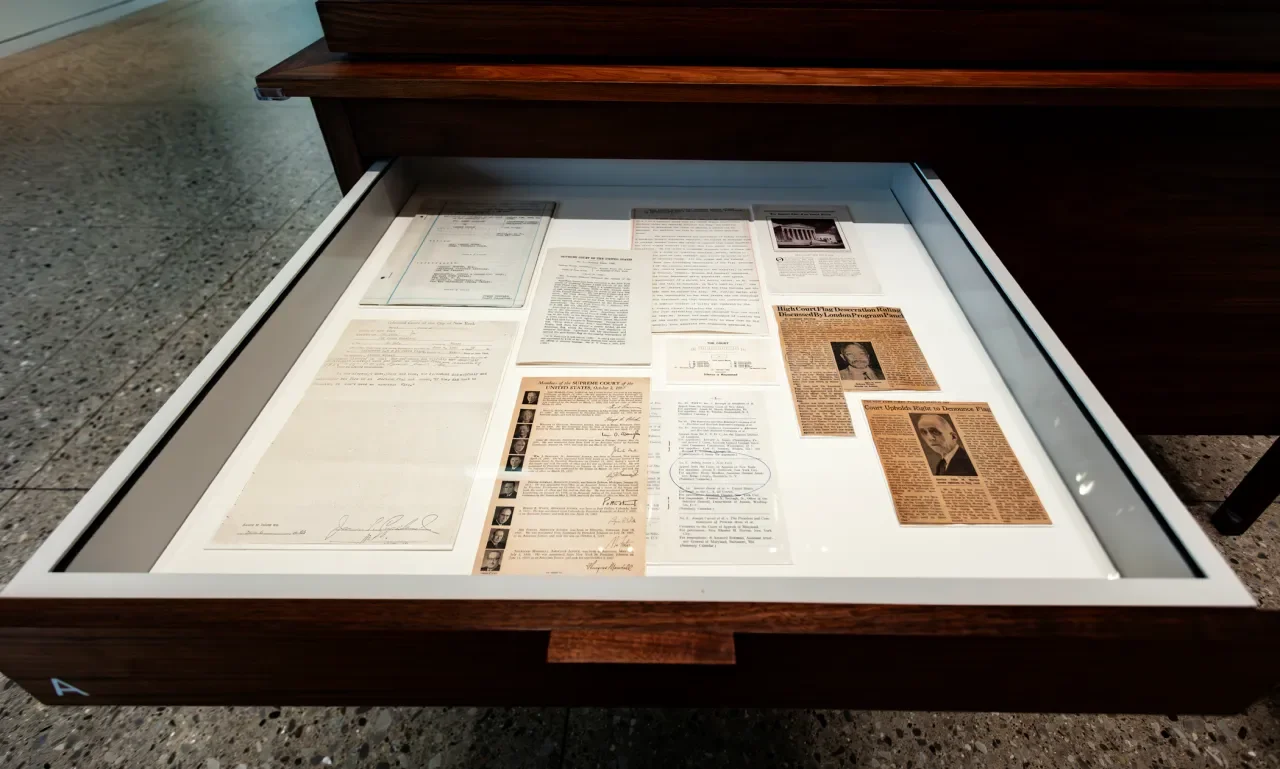
View of “American Sampler,” 2026. Photo: James Rotz.
The exhibition assembles a living archive, presenting posters, correspondence, photographs, and newspaper articles—layered, stacked, and filed—to elucidate the mechanisms by which radical and progressive politics have been articulated, visualized, and thwarted, making change legible as an outcome of concerted collective action and persistent individual efforts in a democratic arena rife with conflict. Rather than proposing a manual for the present, the exhibition speaks to the current moment by underscoring the exercise of public agency that transformed desires and social consciousness through the decades. Visitors are invited to witness and reimagine what has worked, but any suggestion of historical reproducibility is quickly dismissed by the sheer variety of materials and contexts that are constellated evocatively across the towering space. Their arrangement across a triple-height gallery may frustrate a casual viewer’s attempts at making sense of it all. Indeed, Ault puts the onus on the university museum to mediate these histories pedagogically, and on the campus community to mobilize them imaginatively—a timely intervention considering Michigan’s recent policing of political speech and the overnight abandonment of its own lofty diversity, equity, and inclusion proclamations.
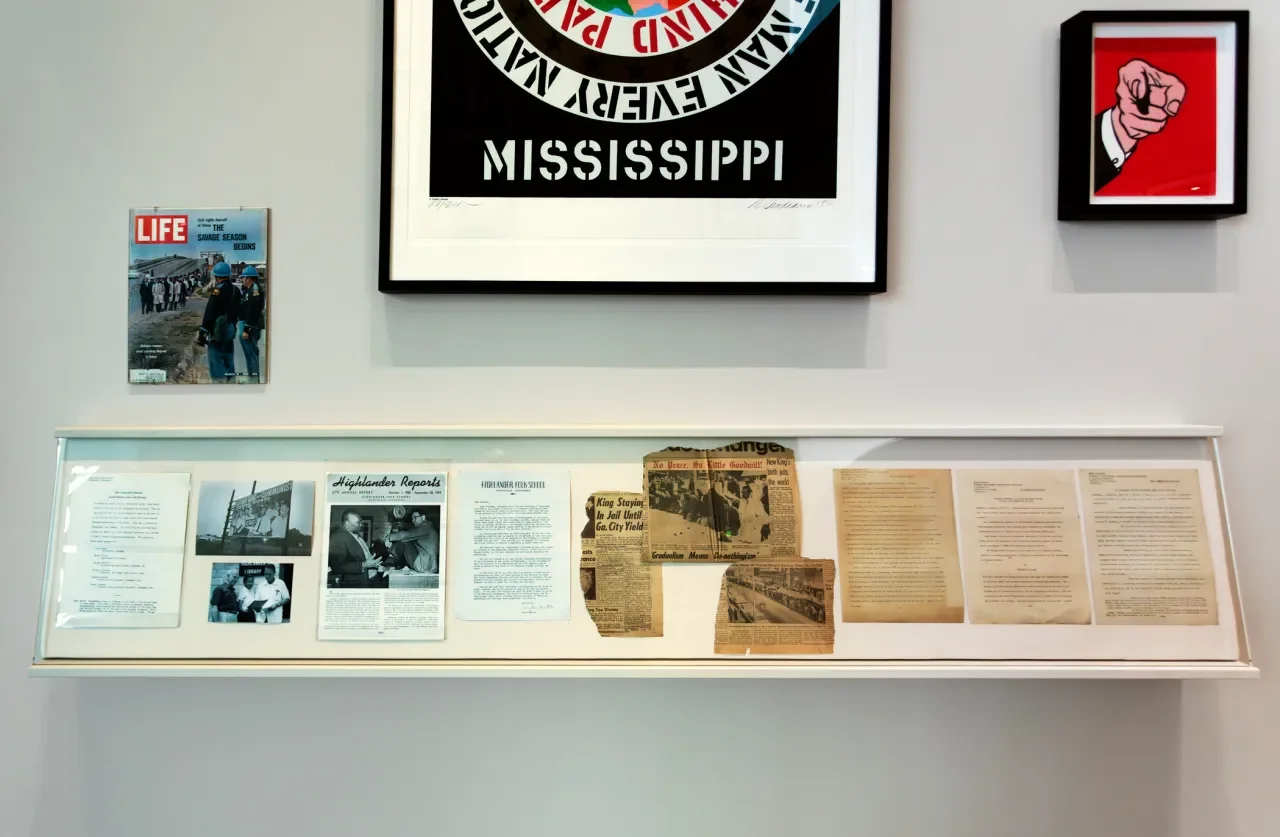
View of “American Sampler,” 2026. Photo: James Rotz.
In the 1969 serigraph that gives the show its title, Corita Kent plays with typography, color, and language in searing ways, revealing the word AMERICAN to contain I CAN, and assassination as enclosing both sin and nation. She puts an I next to VIOLENCE, while placing IM (“I’m”) before and I AM after VIETNAM (anti–Vietnam War organizing is another key thread here). “American Sampler”inadvertently inserts itself into the charged conversation around exhibitions attempting to present “America” on its 250th anniversary. Most recently, global attention drifted to the Venice Biennale, where the political and formal inertness of Alma Allen’s US Pavilion has been widely panned. Ault wisely short-circuits reductive conversations around representations and values, offering us the heterogeneity of a sampler as a rousing resource and a makeshift monument to the significance of sustained resistance.